
Articles
Alpine Convention: Sense and Sensuality
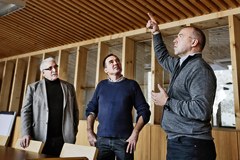
Climate change mitigation in construction and renovation is tantamount to providing for the future; it also makes economic sense. Better still, the Konstruktiv architecture award shows how sustainable construction can also become a sight for sore eyes. CIPRA co-initiated the award in order to publicise exemplary solutions. Imitations expressly permitted!
Climalp/“Alliance in the Alps”: Infected with good ideas
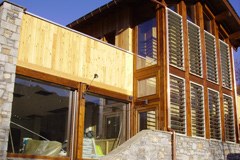
Ideas spread like viruses. They infect someone, who in turn infects someone else, and if they are good and strong, they spread like an epidemic. Energy-efficient construction is one such viral idea. On 14 September 2009 one could observe how it leapt from Vorarlberg to the French department of Savoie. Austria’s westernmost federal province is widely regarded as a centre for innovative timber construction. Concentrated here are a strikingly large number of architects, sawmills and carpenters who use wood as a traditional building material but in an ecologically advanced way – a large-scale workshop for creating a forest-sourced living environment.
Alliance of Central Asian Mountain Communities: Bridges across mountains
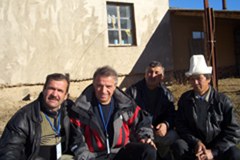
Sometimes the toughest challenges can be presented in the most tender way. On the plate in front of Antonio Zambon is a sheep’s head, braised for hours so that the meat is lovely and tender, eyes included. Expectantly, the Kyrgyz hosts watch their visitor from distant Italy. Quite a quandary. This rustic delicacy is not exactly to his taste; then again, the gesture is intended to honour him as the delegation’s oldest member.
cc.alps climate project: win-win with science
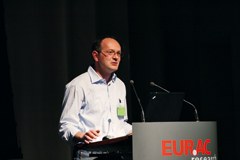
Swiss economic geographer Bruno Abegg has been working with CIPRA for three years. A scientist and a political organisation – how can that work? “It is a clash between two ways of thinking,” says the 45-year-old, which is precisely what he finds so exciting. As the scientific director of the cc.alps project he examines the way in which regions, communities and businesses in the Alps are responding to climate change. CIPRA campaigns to ensure that climate response measures are sustainable. “My research work has always been application-oriented,” says Abegg, “which is why it’s important to me that my findings flow into practical work for the environment.”
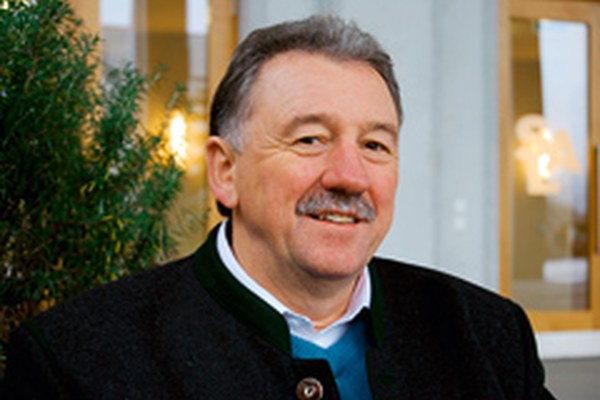
Alpine Town of the Year Association: “No town can afford to ignore climate change mitigation”
Hubert Buhl talks about towns that are pioneering climate change mitigation, environmental role models, and an award capable of changing entire communities.
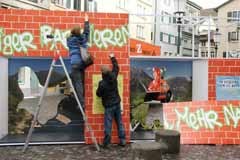
Use "The Wall" at your events to emphasize the importance of ecological connectivity
Are you organizing an event which aims at raising awareness on the problem of habitat fragmentation? Then borrow one of the six colourful installations the "Ecological Continuum Initiative" created for its action "The Wall".
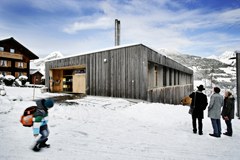
Sustainable Alps: Architecture Prize Awarded
Constructive, the Alpine-wide architecture award for sustainable construction and renovation has been presented to three architects and developers. Three further projects are euqally to be commended.
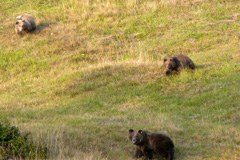
The bear's about!
Clearly the big omnivore feels at home in the Trentino/I. A total of 27 bears were counted there last year, compared with a mere three or four in the 1990s. Meanwhile ten Slovenian bears have settled in the Adamello-Brenta Nature Park as part of the "Life Ursus" campaign.
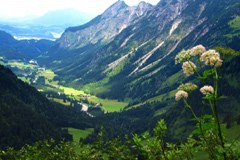
Changing forests
The seminar titled Forestry and Climate Change - Thinking One Step Ahead! looks at the consequences of global warming on the timber industry, forestry and its functions. What sort of strategies are needed to ensure the sustainable development of the forest within the context of regional development?
Methodological guide of the hierarchical ecological networks
The pilot region Isère has published a guide presenting various experiences they led since ten years in different areas and the methods being used. The publication "Methodological guide of the hierarchical ecological networks - Ten years of experiments in Isère" is available in English and French.
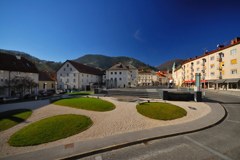
Idrija is the Alpine Town of the Year 2011
The label for sustainable development was awarded to the Slovenian town of Idrija for its commitment to climate protection among other initiatives. The "Alpine Town Year" was ceremoniously inaugurated in February.
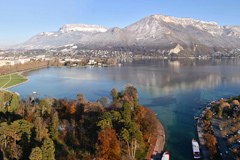
Olympic bid by Annecy: repercussions underestimated
French environmental protection agencies have said that the "impact of the Olympic Games on the environment are widely underestimated in the application documents".
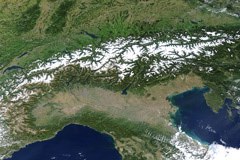
Publication: The Alps in 2010
The new publication titled The Alps by the Permanent Secretariat of the Alpine Convention provides a comprehensive overview of the Alps, including a wealth of cartographic material. For over a thousand years the Alpine landscape has been used as a cultural landscape.
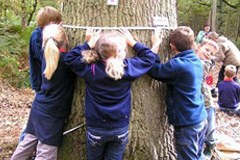
Network of municipalities: new approaches to climate change mitigation
Over the next two years twenty climate change mitigation projects are to be co-financed with around EUR 280,000 by the Alliance in the Alps local authority network. The strategies adopted by local authorities to deal with climate change vary greatly.
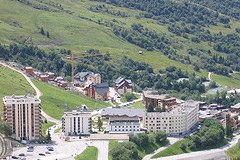
Publication: land management in mountain areas
The current issue of the bilingual Journal of alpine research is running a feature on land management. It is a subject on which scientific research is sparse, even though it is of increasing concern for Alpine local authorities.
Powerline poles: a serious danger for the eagle-owl
Whereas populations of eagle-owl in many parts of Europe slightly increase, they stagnate or slightly reduce in Switzerland. The situation is especially critical in Valais, where only approximately ten breeding pairs are living. In the last twenty years this population has barely changed. According to a new study only ten percent of eagle-owls in Valais survive the first year of their lives. One fourth dies of electric shock when trying to sit on obsolete powerline poles, which do not correspond to current security standards.
Wild cat back in Austrian forests
After more than fifty years, the wild cat returned to Austrian forests. To contribute to protection and a better acceptance of this shy animal among people, the Platform on Wildcats was founded in 2009.
Journal "Conservation Biology" about ecological connectivity and corridors
The April 2010 virtual issue of the journal Conservation biology contains several articles on connectivity and corridors.The articles address phenomena and actions that affect movement of genes, organisms (including humans), and ecological processes.
TransEcoNet: Comprehensive inventory of ecological networks in Central Europe finished
The TransEcoNet project strives for a better connection of protected and less or unprotected landscapes across national borders in Central Europe. One focus of the project during its first half of implementation has been the analysis of existing transboundary ecological networks, their status of biodiversity and the detection of gaps in these networks.
Fragmentation of Stelvio National Park management
A committee composed of members of the Italian government, the region Lombardy and the automous provinces of Trento and Bolzano has decided that the Stelvio national park/I should be run directly by local authorities. It foresees that the park will be managed by the Autonomous Provinces of Trento and Bolzano and the Region Lombardy, in collaboration with the municipalities concerned. According to WWF Italy, this could lead to an unnecessary and potentially damaging administrational fragmentation of the Park.
Renewed website Ecological Networks in the European Alps
The Ecological Continuum Initiative has launched its renewed webpage. Apart from the new appealing graphic design the website is also richer in information in German, French, Italian and Slovenian language such as publications, links, events and news. Therefore the website is more attractive for a wide public.
"The Wall": Less barriers, more life!
Stop - no way through! On 20th of October 2010 a giant wall blocked the way of pedestrians in Zurich/CH, Vienna/A, Munich/D, Ljubljana/SI, Milan/I and Lyon/F. For animals, it's the same every day: streets and settlements increasingly fragment their migration routes.
Dear colleagues and friends of the Ecological Continuum Initiative,
The international year of biodiversity is coming to an end. 2010 represented a unique opportunity to highlight the importance of biodiversity conservation. The topic had a large echo in the media, thanks to numerous events, new publications, TV reports etc. The year was also fruitful for ecological connectivity - a not so simple topic that received unprecedented media attention. In 2010 the Ecological Continuum Initiative's main focus was on communication. Many articles were published in specialized media. However our main achievement was "The Wall" event. Its aim was to bring home our message on the need for ecological connectivity, carrying it across the whole Alpine space, across administrative, language and cultural boundaries. We succeeded. Pedestrians in six Alpine cities were confronted with a big barrier blocking their paths: an obstacle much like those encountered by animals and plants every day. The public had therefore a chance to experience first hand the problem of habitat fragmentation. The event attracted the attention of local and national media in the Alpine countries. Thanks to "The Wall" the topic of ecological connectivity has reached many more people than is normally the case for such "technical" subjects. It is an important achievement in which we intend to build further awareness-raising initiatives.
A media house for the Alps
The Alps are to have their own multilingual media platform. This ambitious idea was launched by the Rhaeto-Romanic department of Switzerland's public radio broadcaster. Las-Alps-Infoteca is to become "a competence centre for media in the Alps, providing news and information from the Alps and about the Alps".
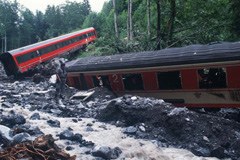
Natural hazards: an incalculable risk for road and rail?
Time and time again avalanches, debris-flows and rock falls result in roads being blocked and railway tracks being swept away, causing fatalities. The Alpine Space Project PARAmount is looking to bridge the gap between society's demands on transportation routes and the outline conditions defined by nature.
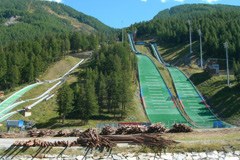
Olympic Games: no benefit to the national economy
Switzerland is once again discussing its candidacy for the 2022 Winter Olympics. Environmental organisations are warning against the ecological and economic repercussions. Even Marco Blatter, former CEO of Swiss Olympic, has been quoted on Swiss radio, saying that he was glad the 2006 Games were not held in the Valais. He added that in Turin/I the Games had grown out of all proportion. "With all the infrastructure investments Turin cost around CHF 4.5 bn; Vancouver is costing around CHF 6 bn; and Sochi 2014 is officially budgeting for CHF 13 bn," reports Switzerland's SonntagsZeitung.
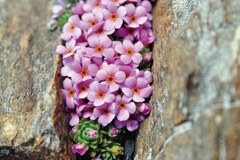
Biodiversity in times of climate change: management or wilderness?
The concrete impact of climate change on biodiversity is still uncertain. However it is expected to be visible particularly in the behaviour of the flora and fauna in the Alps and also to be different for each species. The habitat of butterflies such as the marbled ringlet (Erebia montana) is set to shrink, alike the grouse's. But in a different way, because the grouse is more severely impacted by land use than by climate change.
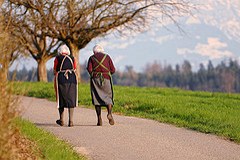
Conference on demographic change in the Alpine region
The Alpine Space Forum, to be held in Innsbruck/A from 22 to 23 February 2011, focuses on coping with demographic change in the Alpine region. The Alps are particularly affected as settlement areas are limited and many Alpine communities are located in the peripheries.
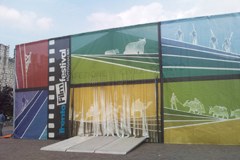
MontagnaLibri is looking for books on mountains
Preparations for the 2011 international mountain book fair MontagnaLibri are well underway. Authors and publishers are now invited to submit any books, magazines or studies published between 2007 and 2010.
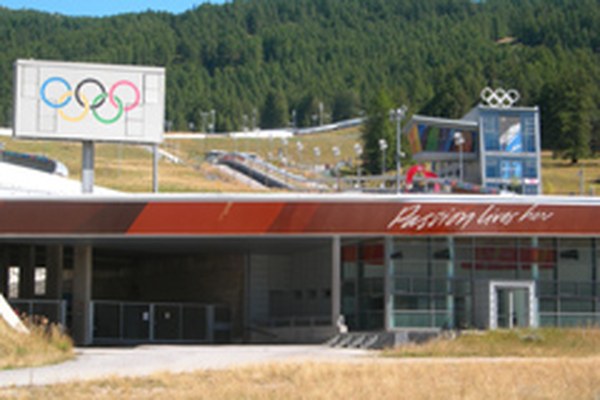
The shreds of Turin
Mountain regions are footing the bill for the Winter Olympics - the Winter Olympics bring fame and glory and an economic revival to the regions. For a fortnight. Leaving behind an oversized infrastructure, debts and empty beds. That, in a nutshell, is Turin four years after the 20th Olympic Winter Games.