Political positions of CIPRA

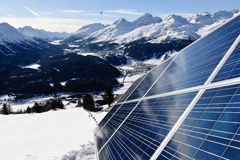
Make the Alps energy self-sufficient! CIPRA-demands - Energy self-sufficient regions
Not having to depend on energy imports: this vision holds great fascination for many regions. Self-sufficiency is "in." There are already many very positive approaches and examples of attempts to go down this road. At the heart of all the concepts is the idea of meeting demand through regional renewable sources of energy, saving energy and using energy more efficiently. Anyone who systematically takes this approach in an attempt to create an energy self-sufficient region changes the face of their region and its structures - to the benefit of their own economy, society and the environment.
cc.alps: CIPRA's demands for agriculture
The agricultural sector is directly affected by climate change impacts but it also contributes to the release of greenhouse gases (GHG) and rising concentrations of GHG in the atmosphere. A sustainable climate response strategy in the field of agriculture involves anticipating, planning and long-term thinking from farm level to transnational level. Prominent fields of activity are sustainable land and soil management, sustainable water management, managing manure and soil carbon as well as organic agriculture as an overall strategy. As agriculture is a highly subsidized economic sector, subvention policy can be used as a lever to guide the sector to sustainability and climate neutrality.
Only climate-friendly tourism is sustainable: cc.alps - CIPRA’s demands for tourism in climate change
Climate change is a major challenge to Alpine tourism. It has to adapt to climate change and at the same time become more climate-friendly. There is a particularly large potential for reduction of CO2 emissions in the key areas of traffic and energy. Tourism is a branch of the economy which is heavily subsidized. Therefore public policy can and must direct developments towards sustainability through the support given to tourism. The present discussion about developments in the tourism industry is dominated by the large chair lift companies which are essentially fixed on ski tourism and the maintenance of the status quo. But focusing only on snow and skiing means promoting a capital-intensive, highly technological form of Alpine tourism and a monoculture. This is neither climatologically nor environmentally sustainable.

News on Alpine Politics

How much hydropower is ecologically sustainable ?
Renovate power plants instead of building new ones, preserve the last freshwater pearls, coordinate use and protection across countries: CIPRA has published a position paper with detailed technical demands on the use of hydropower in the Alps.
Point of view: Water will not tolerate resistance
Extreme weather conditions are also increasingly affecting the Alps. The climate crisis is driving this development. Can more and more dams, barriers or power stations solve the problem and at the same time satisfy the growing hunger for energy? We must work with the power of water rather than against it, says Kaspar Schuler, CIPRA’s Executive Director and co-author of CIPRA’s new position paper on hydropower.
Under the magnifying glass
What treasures and resources are hidden in the Alps? How do we deal with them as sustainably as possible? These and similar questions are posed in the August 2021 issue of SzeneAlpen.
Mobile in the Alps
Mobile in the Alps
By rail, by road, by mountain path: numerous CIPRA projects show just how diverse sustainable mobility can be.

Point of view of CIPRA

Point of view: He who sows infrastructure, reaps more traffic
At the end of February 2016 Swiss voters will decide on the building of a second road tunnel at the Gotthard Pass. The CHF 4 billion project will torpedo Switzerland’s modal shift policy, believes Barbara Wülser, CIPRA International’s communications manager.

Point of view: Change begins in the heart
Claire Simon, Executive Director of CIPRA International, used the occasion of the 2015 CIPRA annual conference to call for more engagement with people and their ways of thinking in order to strengthen the natural and cultural diversity of the Alps.

Point of view: Making the Alpine Convention more interactive
The effectiveness of the Alpine Convention is often called into question. A new approach could help reposition it as an engine of co-operation and sustainable development in the Alpine regions, says Claire Simon, Executive Director of CIPRA International.