
News
One step further towards ecological connectivity in France
The French law on ecological networks ("trame verte et bleue") has recently been updated with two decrees, which asses and divide the implementation roles of the state and the regions. Further information: www.actu-environnement.com/ae/news
Life+ Projects increasing ecological connections along the Alps-Apennines corridor and in Lapland
In the frame of the LIFE+ Nature & Biodiversity programme 2010 two projects regarding ecological connectivity have been implemented. The objective of the project in Lombardy, Italy, is to increase the functionality of the ecological corridor between the Alps and the Apennines.
NGOs send joint message on the EU biodiversity strategy
A group of 22 nature conservation NGOs, joined in The European Habitat Forum EHF, have expressed their beliefs that increased political effort is required at EU and Member State level to meet the new EU biodiversity target of halting the loss of biodiversity and ecosystem services in the EU by 2020.
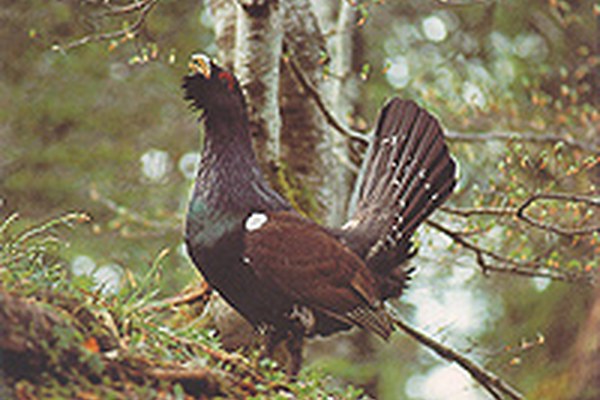
From ecological islands to connected landscapes
Many animals live in particular outside of protected areas; most persons are not aware of the importance of ecological networks; a functioning economy needs biodiversity. These are the most important findings of ECONNECT. The Alpine-wide project came to its end in November 2011 after a bit more than three years of work.
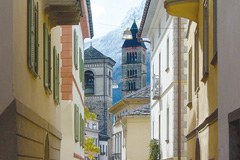
The Alps are renewed in Poschiavo
On what sort of resources are the Alps building their future? Can climate change be an opportunity? What ought to be done to ensure that young people have prospects? The Alpine Week being held in the Swiss valley of Val Poschiavo from 5 to 8 September 2012 aims to discuss just how renewable the Alps actually are.
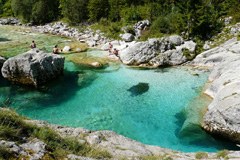
Soča valley soon under water?
The proposal was made by Slovenia's Ministry of Economic Affairs just before the summer break. Five hydroelectric power plants are to be built on the Soča river and its tributaries, the Ucja and Idrijca.
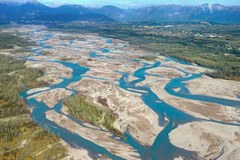
Respite for the "king of the Alpine rivers"
It looks like no gravel is to be extracted from the Tagliamento for the time being. The company that was planning to extract more than a million cubic metres of ballast between Cimano/I and the Arzino tributary has withdrawn its project.
New tool for custom-made connectivity solutions
Do you want to facilitate the migration of animals within and between their habitats? There are many different ways to do this. Whether you are a farmer, a mayor or leading a tourist company: the detailed search of the new online "measures catalogue" shows you possible activities to improve ecological connectivity that are adapted to your individual situation.
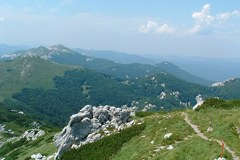
Dinaric Alps Conference: laying the foundations for the protection of the Dinaric Alps
The countries of the Dinaric Alps met in Brdo near Kranj, Slovenia, on March 8 and 9 for the first ever Dinaric Alps Conference. Concurrently the ministers of the Alpine states convened at the 11th Alpine Conference.
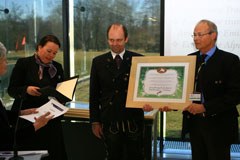
Five Econnect pilot regions officially rewarded at the Alpine Conference
On 8 March 2011 the Alpine Conference has officially recognised and rewarded eight Alpine regions - among which five Econnect pilot regions - for their exemplary work aiming at the creation of an alpine ecological network.
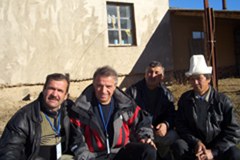
Alliance of Central Asian Mountain Communities: Bridges across mountains
Sometimes the toughest challenges can be presented in the most tender way. On the plate in front of Antonio Zambon is a sheep’s head, braised for hours so that the meat is lovely and tender, eyes included. Expectantly, the Kyrgyz hosts watch their visitor from distant Italy. Quite a quandary. This rustic delicacy is not exactly to his taste; then again, the gesture is intended to honour him as the delegation’s oldest member.
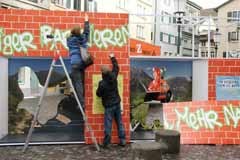
Use "The Wall" at your events to emphasize the importance of ecological connectivity
Are you organizing an event which aims at raising awareness on the problem of habitat fragmentation? Then borrow one of the six colourful installations the "Ecological Continuum Initiative" created for its action "The Wall".
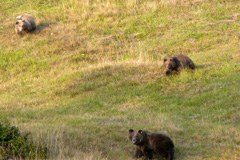
The bear's about!
Clearly the big omnivore feels at home in the Trentino/I. A total of 27 bears were counted there last year, compared with a mere three or four in the 1990s. Meanwhile ten Slovenian bears have settled in the Adamello-Brenta Nature Park as part of the "Life Ursus" campaign.
Methodological guide of the hierarchical ecological networks
The pilot region Isère has published a guide presenting various experiences they led since ten years in different areas and the methods being used. The publication "Methodological guide of the hierarchical ecological networks - Ten years of experiments in Isère" is available in English and French.
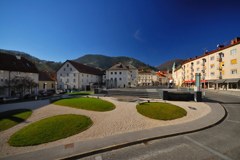
Idrija is the Alpine Town of the Year 2011
The label for sustainable development was awarded to the Slovenian town of Idrija for its commitment to climate protection among other initiatives. The "Alpine Town Year" was ceremoniously inaugurated in February.
Powerline poles: a serious danger for the eagle-owl
Whereas populations of eagle-owl in many parts of Europe slightly increase, they stagnate or slightly reduce in Switzerland. The situation is especially critical in Valais, where only approximately ten breeding pairs are living. In the last twenty years this population has barely changed. According to a new study only ten percent of eagle-owls in Valais survive the first year of their lives. One fourth dies of electric shock when trying to sit on obsolete powerline poles, which do not correspond to current security standards.
Wild cat back in Austrian forests
After more than fifty years, the wild cat returned to Austrian forests. To contribute to protection and a better acceptance of this shy animal among people, the Platform on Wildcats was founded in 2009.
Journal "Conservation Biology" about ecological connectivity and corridors
The April 2010 virtual issue of the journal Conservation biology contains several articles on connectivity and corridors.The articles address phenomena and actions that affect movement of genes, organisms (including humans), and ecological processes.
TransEcoNet: Comprehensive inventory of ecological networks in Central Europe finished
The TransEcoNet project strives for a better connection of protected and less or unprotected landscapes across national borders in Central Europe. One focus of the project during its first half of implementation has been the analysis of existing transboundary ecological networks, their status of biodiversity and the detection of gaps in these networks.
Fragmentation of Stelvio National Park management
A committee composed of members of the Italian government, the region Lombardy and the automous provinces of Trento and Bolzano has decided that the Stelvio national park/I should be run directly by local authorities. It foresees that the park will be managed by the Autonomous Provinces of Trento and Bolzano and the Region Lombardy, in collaboration with the municipalities concerned. According to WWF Italy, this could lead to an unnecessary and potentially damaging administrational fragmentation of the Park.
Renewed website Ecological Networks in the European Alps
The Ecological Continuum Initiative has launched its renewed webpage. Apart from the new appealing graphic design the website is also richer in information in German, French, Italian and Slovenian language such as publications, links, events and news. Therefore the website is more attractive for a wide public.
"The Wall": Less barriers, more life!
Stop - no way through! On 20th of October 2010 a giant wall blocked the way of pedestrians in Zurich/CH, Vienna/A, Munich/D, Ljubljana/SI, Milan/I and Lyon/F. For animals, it's the same every day: streets and settlements increasingly fragment their migration routes.
Dear colleagues and friends of the Ecological Continuum Initiative,
The international year of biodiversity is coming to an end. 2010 represented a unique opportunity to highlight the importance of biodiversity conservation. The topic had a large echo in the media, thanks to numerous events, new publications, TV reports etc. The year was also fruitful for ecological connectivity - a not so simple topic that received unprecedented media attention. In 2010 the Ecological Continuum Initiative's main focus was on communication. Many articles were published in specialized media. However our main achievement was "The Wall" event. Its aim was to bring home our message on the need for ecological connectivity, carrying it across the whole Alpine space, across administrative, language and cultural boundaries. We succeeded. Pedestrians in six Alpine cities were confronted with a big barrier blocking their paths: an obstacle much like those encountered by animals and plants every day. The public had therefore a chance to experience first hand the problem of habitat fragmentation. The event attracted the attention of local and national media in the Alpine countries. Thanks to "The Wall" the topic of ecological connectivity has reached many more people than is normally the case for such "technical" subjects. It is an important achievement in which we intend to build further awareness-raising initiatives.
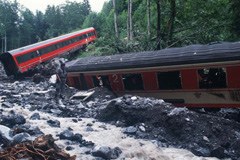
Natural hazards: an incalculable risk for road and rail?
Time and time again avalanches, debris-flows and rock falls result in roads being blocked and railway tracks being swept away, causing fatalities. The Alpine Space Project PARAmount is looking to bridge the gap between society's demands on transportation routes and the outline conditions defined by nature.
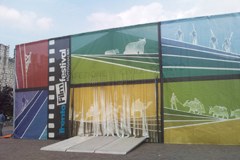
MontagnaLibri is looking for books on mountains
Preparations for the 2011 international mountain book fair MontagnaLibri are well underway. Authors and publishers are now invited to submit any books, magazines or studies published between 2007 and 2010.
Legal barriers and potentials for a pan-Alpine ecological network
A synthesis report from the international technical seminar in the frame of the "legal barrier" work package of Econnect, which took place on 6 May in Grenoble/F, is now available. In the focus of the seminar was the question "How can legal instruments contribute to the objectives of ecological connectivity in the Alps?".
Publication on the challenges facing mountain regions
The Institute for Mountain Research at Innsbruck University/A has published a book on man and the environment in mountain areas under the English original title Challenges for Mountain Regions - Tackling Complexity. Besides the Alps it also examines mountain areas in the Andes and Patagonia.
European mountain areas: focusing on trendsetting projects
In mid-September 350 experts and interested participants from 23 countries gathered in Lillehammer/NO to discuss the implementation of innovative projects in European mountain areas. By now in the mountains of Europe there are already multiple trendsetting projects in progress. One of the conclusions reached by the experts is that a better usage needs to be made of that potential, and that it also needs to be expanded further.
The true value of our mountains
The European Environmental Agency (EEA) has just published a new report titled Europe's ecological backbone: recognising the true value of our mountains. The report provides a comprehensive analysis of population numbers, ecosystems, water cycles, land use, and policies in mountain regions. The report focuses its attention on forces and interactions between the various issues and their impact on Europe's mountain areas.
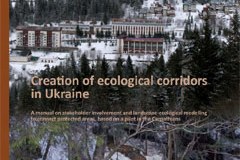
Experiences from the Carpathians: a manual on creation of ecological corridors
Based on a pilot project of realizing trans-boundary ecological connectivity in the Ukrainian Carpathians a manual on stakeholder involvement and landscape-ecological modeling to connect protected areas has recently been published.