
News
MIREN: a new network looks at invasive plants in mountain regions
MIREN (Mountain Invasion Research Network) is a new global research network that was founded this summer as part of a workshop in Vienna/A. It focuses on the problem of invasive plants in mountain regions, particularly from the aspect of global change.
Decrease in water runoff from the Swiss Alps
A new study analyses the impact of a potential climate change on hydrological discharge regimes from the Swiss Alpine region for the period between 2020 and 2050. Eleven catchment areas with different glaciation rates and altitude ranges were examined.
Climate protection measures for a hot Bavaria
Representatives of Bavaria's Ministries of the Environment, Economic Affairs, Agriculture and the Interior, and of the Bund Naturschutz have agreed on around a dozen climate protection measures in a further step in implementing the Climate Protection Alliance they concluded in 2004.
Trading emissions to achieve "zero emissions" target at the Olympic Games
Turin/I is aiming to maximise the reduction in the output of greenhouse gases during the forthcoming Winter Olympics with the aid of its HECTOR (Heritage Climate Torino) programme launched in 2004.
Insufficient snowfall a cause of recessive glaciers
Lower winter precipitation has been one of the causes, along with global warming, behind melting glaciers over the past 150 years. These are the main findings of a study by researchers at the Laboratoire de glaciologie et géophysique de Grenoble/F and the Eidgenössische Technische Hochschule Zurich/CH, published in the Geophysical Research Letters.
New book: the good alpine air
A new publication in the series "Revue de géographie alpine/journal of alpine research" is devoted to the subject of the air in the Alps. The mountain air has played a major role in the history of the Alps since the end of the 18th century.
Mistletoe area boundaries on the ascendant
Scientists at the Swiss Federal Institute for Forest Snow and Landscape Research have found specimens of mistletoe at altitudes of up to 1500 m. It was previously thought that in Switzerland mistletoe grew only in areas below 1000 m above sea level.
Major climate change as a threat to the flora and fauna
A new study published by WWF International addresses the threat of rapid climate change and its impacts on the flora and fauna. For many species, the natural mechanisms of adaptation are no longer capable of coping with the sheer speed of change.
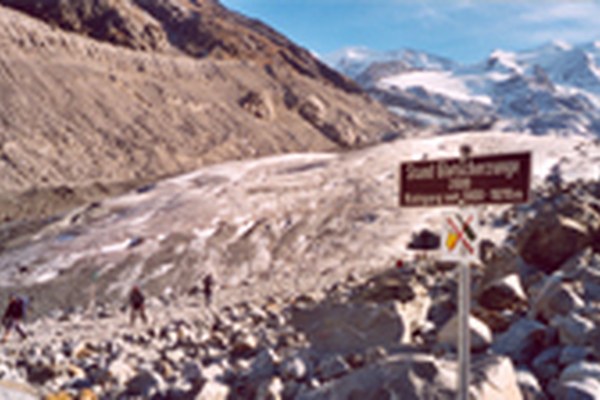
Glaciers melting faster than anticipated
A new study by Zurich University using satellite images to analyse the surface area of 930 glaciers has shown that Switzerland's glaciers lost around 18% of their surface area between 1985 and 2000.
Greater co-operation to protect against natural hazards
Switzerland, Germany, Austria and Liechtenstein intend to co-operate even more closely to protect against natural hazards in the Alps. This decision was taken by the four German-language Environmental Ministers at this year's meeting in Potsdam/D. The Ministers concurred that natural catastrophes in the Alps were likely to occur more and more often despite all the efforts being made with regard to climate protection.
Europe's changing climate and the hot summer of 2003
Europe's climate has changed considerably over the past one hundred years, and the impact of that change is visible in many areas. An extensive study in English by the European Environment Agency (EEA) shows that Alpine glaciers for instance have lost more than half their ice mass.
Ford Environment Award 2004: Special Award for Climate Protection
The Ford Environment Award of the Austrian Umbrella Organisation for the Environment and the Ford Motor Company Austria rewards with a total of €16,000.00 the three best initiatives for the protection of the country's natural and cultural heritage.
UNO confirms global warming poses threat to winter sports everywhere
According to a new study on the economic repercussions of the climate change on winter sports many low-altitude ski resorts are set to face financial difficulties or even bankruptcy due to global warming. The study was commissioned by the UN Environmental Program and presented at the World Conference on Sport and the Environment in Turin/I on 2 December.