
News
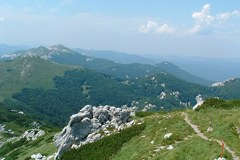
Dinaric Alps Conference: laying the foundations for the protection of the Dinaric Alps
The countries of the Dinaric Alps met in Brdo near Kranj, Slovenia, on March 8 and 9 for the first ever Dinaric Alps Conference. Concurrently the ministers of the Alpine states convened at the 11th Alpine Conference.
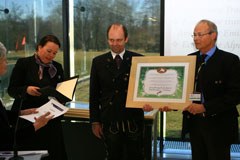
Five Econnect pilot regions officially rewarded at the Alpine Conference
On 8 March 2011 the Alpine Conference has officially recognised and rewarded eight Alpine regions - among which five Econnect pilot regions - for their exemplary work aiming at the creation of an alpine ecological network.
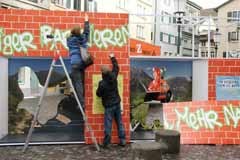
Use "The Wall" at your events to emphasize the importance of ecological connectivity
Are you organizing an event which aims at raising awareness on the problem of habitat fragmentation? Then borrow one of the six colourful installations the "Ecological Continuum Initiative" created for its action "The Wall".
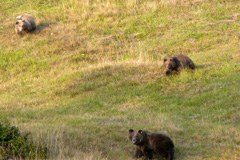
The bear's about!
Clearly the big omnivore feels at home in the Trentino/I. A total of 27 bears were counted there last year, compared with a mere three or four in the 1990s. Meanwhile ten Slovenian bears have settled in the Adamello-Brenta Nature Park as part of the "Life Ursus" campaign.
Methodological guide of the hierarchical ecological networks
The pilot region Isère has published a guide presenting various experiences they led since ten years in different areas and the methods being used. The publication "Methodological guide of the hierarchical ecological networks - Ten years of experiments in Isère" is available in English and French.
Powerline poles: a serious danger for the eagle-owl
Whereas populations of eagle-owl in many parts of Europe slightly increase, they stagnate or slightly reduce in Switzerland. The situation is especially critical in Valais, where only approximately ten breeding pairs are living. In the last twenty years this population has barely changed. According to a new study only ten percent of eagle-owls in Valais survive the first year of their lives. One fourth dies of electric shock when trying to sit on obsolete powerline poles, which do not correspond to current security standards.
Wild cat back in Austrian forests
After more than fifty years, the wild cat returned to Austrian forests. To contribute to protection and a better acceptance of this shy animal among people, the Platform on Wildcats was founded in 2009.
Journal "Conservation Biology" about ecological connectivity and corridors
The April 2010 virtual issue of the journal Conservation biology contains several articles on connectivity and corridors.The articles address phenomena and actions that affect movement of genes, organisms (including humans), and ecological processes.
TransEcoNet: Comprehensive inventory of ecological networks in Central Europe finished
The TransEcoNet project strives for a better connection of protected and less or unprotected landscapes across national borders in Central Europe. One focus of the project during its first half of implementation has been the analysis of existing transboundary ecological networks, their status of biodiversity and the detection of gaps in these networks.
Fragmentation of Stelvio National Park management
A committee composed of members of the Italian government, the region Lombardy and the automous provinces of Trento and Bolzano has decided that the Stelvio national park/I should be run directly by local authorities. It foresees that the park will be managed by the Autonomous Provinces of Trento and Bolzano and the Region Lombardy, in collaboration with the municipalities concerned. According to WWF Italy, this could lead to an unnecessary and potentially damaging administrational fragmentation of the Park.
Renewed website Ecological Networks in the European Alps
The Ecological Continuum Initiative has launched its renewed webpage. Apart from the new appealing graphic design the website is also richer in information in German, French, Italian and Slovenian language such as publications, links, events and news. Therefore the website is more attractive for a wide public.
"The Wall": Less barriers, more life!
Stop - no way through! On 20th of October 2010 a giant wall blocked the way of pedestrians in Zurich/CH, Vienna/A, Munich/D, Ljubljana/SI, Milan/I and Lyon/F. For animals, it's the same every day: streets and settlements increasingly fragment their migration routes.
Dear colleagues and friends of the Ecological Continuum Initiative,
The international year of biodiversity is coming to an end. 2010 represented a unique opportunity to highlight the importance of biodiversity conservation. The topic had a large echo in the media, thanks to numerous events, new publications, TV reports etc. The year was also fruitful for ecological connectivity - a not so simple topic that received unprecedented media attention. In 2010 the Ecological Continuum Initiative's main focus was on communication. Many articles were published in specialized media. However our main achievement was "The Wall" event. Its aim was to bring home our message on the need for ecological connectivity, carrying it across the whole Alpine space, across administrative, language and cultural boundaries. We succeeded. Pedestrians in six Alpine cities were confronted with a big barrier blocking their paths: an obstacle much like those encountered by animals and plants every day. The public had therefore a chance to experience first hand the problem of habitat fragmentation. The event attracted the attention of local and national media in the Alpine countries. Thanks to "The Wall" the topic of ecological connectivity has reached many more people than is normally the case for such "technical" subjects. It is an important achievement in which we intend to build further awareness-raising initiatives.
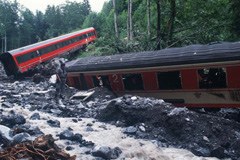
Natural hazards: an incalculable risk for road and rail?
Time and time again avalanches, debris-flows and rock falls result in roads being blocked and railway tracks being swept away, causing fatalities. The Alpine Space Project PARAmount is looking to bridge the gap between society's demands on transportation routes and the outline conditions defined by nature.
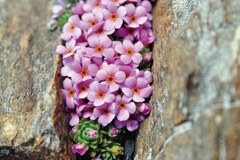
Biodiversity in times of climate change: management or wilderness?
The concrete impact of climate change on biodiversity is still uncertain. However it is expected to be visible particularly in the behaviour of the flora and fauna in the Alps and also to be different for each species. The habitat of butterflies such as the marbled ringlet (Erebia montana) is set to shrink, alike the grouse's. But in a different way, because the grouse is more severely impacted by land use than by climate change.
Legal barriers and potentials for a pan-Alpine ecological network
A synthesis report from the international technical seminar in the frame of the "legal barrier" work package of Econnect, which took place on 6 May in Grenoble/F, is now available. In the focus of the seminar was the question "How can legal instruments contribute to the objectives of ecological connectivity in the Alps?".
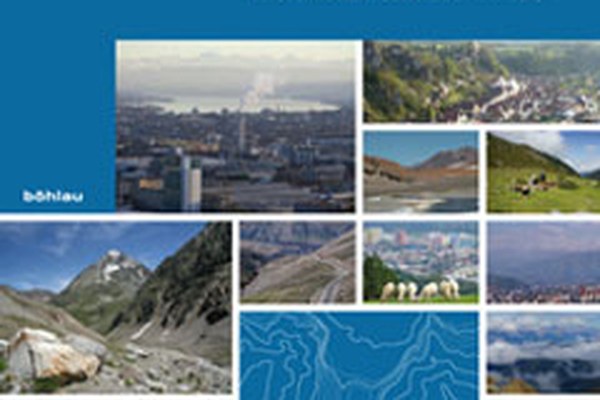
Publication on the challenges facing mountain regions
The Institute for Mountain Research at Innsbruck University/A has published a book on man and the environment in mountain areas under the English original title Challenges for Mountain Regions - Tackling Complexity. Besides the Alps it also examines mountain areas in the Andes and Patagonia.

Calm and collected in a heated discussion: Pascale Poblet, CCP Project Manager "There's no stress involved in travelling by bus or by bike."
With a commuter plan that encourages the use of modes of transport other than cars the STMicroelectronics and ST-Ericsson site in Grenoble/F is committed to eco- and climate-friendly mobility. For this initiative the company was awarded one of the cc.alps competition prizes worth 10,000 euros. Pascale Poblet, CCP (Company Commuter Plan) Project Manager, explains why the company's workforce is in such great shape and why the company's kitty has benefited as a result.
The true value of our mountains
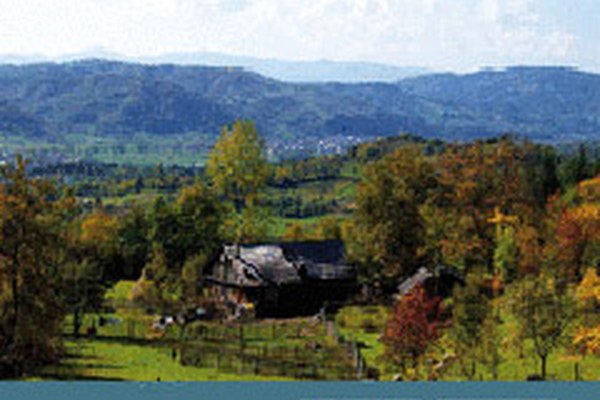
The European Environmental Agency (EEA) has just published a new report titled Europe's ecological backbone: recognising the true value of our mountains. The report provides a comprehensive analysis of population numbers, ecosystems, water cycles, land use, and policies in mountain regions. The report focuses its attention on forces and interactions between the various issues and their impact on Europe's mountain areas.
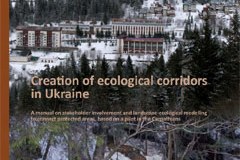
Experiences from the Carpathians: a manual on creation of ecological corridors
Based on a pilot project of realizing trans-boundary ecological connectivity in the Ukrainian Carpathians a manual on stakeholder involvement and landscape-ecological modeling to connect protected areas has recently been published.
First atlas of biodiversity risk in Europe
The new "Atlas of Biodiversity Risk" is the first of its kind to describe and summarise in a comprehensive, easy-to-read and richly illustrated form the major pressures, impacts and risks of biodiversity loss on a European and global level.
55 questions on alpine ecological connectivity
A joint research project of Econnect, the Platform Ecological Network under the Alpine Convention and the Ecological Continuum Initiative aims to identify "The 55 most urgent questions concerning ecological networks in the Alps" by bringing together all "alpine actors" such as national administrations, protected areas, researchers, stakeholders and various NGOs.
Less barriers, more nature!
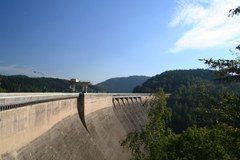
Every day we build new obstacles on the migrating routes for animals and we prevent plants to spread freely. In most of the cases we are not even aware of this problem. How would it feel and look like, if our living spaces would suddenly get fragmented by obstacles we cannot easily overcome?
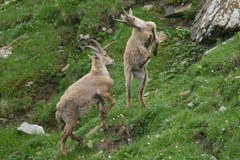
Gran Paradiso National Park: what is causing young ibexes to die out?
Since the foundation of Italy's first national park in 1922, the Alpine Ibex has been preserved from extinction for the past 100 years or so. Now the ibex population at the Gran Paradiso National Park/I is seriously at risk. Three quarters of the young animals are dying during their first year of life. In 1993 the population totalled around 5'000 animals; today the population at the Gran Paradiso National Park is just under half that number. It is still unclear what is causing the death of the young bi-ungulates.
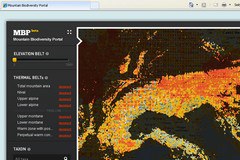
Europe's mountains: rich in biodiversity but increasingly vulnerable
In its study 10 Messages for 2010 - Mountain Ecosystems the European Environmental Agency takes a closer look at Europe's mountain regions. Compared with the lowlands, regions above the tree line are home to a richer variety of plant and animal species. The biggest threats include land abandonment, intensification of agriculture, infrastructure development, unsustainable exploitation and climate change.
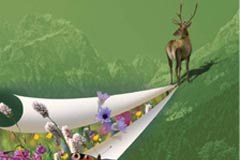
New publications for networking natural environments in the Alps
A great deal has been done and achieved in recent years to set up a pan-alpine ecological network. As part of its script series the German Federal Agency for Nature Conservation (BfN) has just published a report in English entitled Implementing a Pan-Alpine Ecological Network - A Compilation of Major Approaches, Tools and Activities. It comprises for the first time various documents, publications and reports supporting the implementation of an ecological network across the alpine arc. One chapter focuses on activities in the Carpathians. The publication can provide useful information to regions beyond the Alps, too.
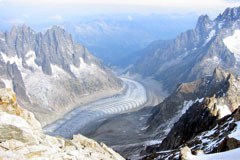
First transnational permafrost map of the Alps
The first standardised permafrost monitoring map of the Alpine Space is to be drawn up by researchers from Austria, Italy, Switzerland, France and Germany by 2011. The map will allow a better assessment of natural hazards and play an important role particularly for tourism and the growing infrastructure in the high-alpine region.
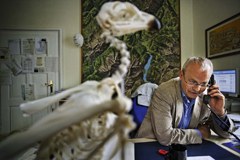
Nature abhors borders: Ecological Continuum and Econnect
CIPRA sees itself as something of a networker. And this applies to nature conservation as well. It brings officials, local authorities and scientists together, regardless of national borders. After all, animal and plant migrations don’t stop at border barriers either.
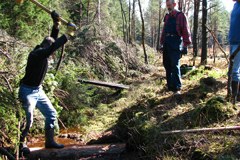
Fen felling
It‘s 7 am in early summer. A clack, clack sound drifts through the veil of mist hanging over the Ödmoos area of Bavaria. Work is already in full swing. You need to start early, as it gets very hot during the day. Stefan raises his axe and starts to hack away at the clumps of bushes. The 23-year-old is studying forestry science and works as a volunteer restoring the area‘s natural habitat. He has always had a keen interest in fens and bogs as diverse habitats, ever since he was a boy. And now he also knows that they make a valuable contribution to climate protection.
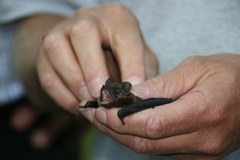
The chestnut forest plays host to a rare guest: Alliance in the Alps network of municipalities
The little bat somehow looked different. Filigree in form, brownish in colour, and with a ringed wing it huddled in the corner of the nesting box on the chestnut tree. Nicola Zambelli put on his gloves and pulled gently on the wing tip to examine the ring.