
News
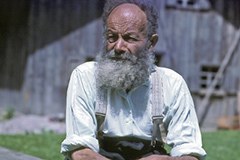
The future of farming in the mountains
The European Union is negotiating the Common Agricultural Policy (CAP). If the "Alliance for Agriculture and Nature Protection in the Alpine Regions" has its way, farming in the mountains will be given particular consideration. The alliance has now submitted its catalogue of demands.
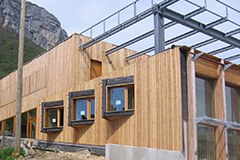
In summer cool, in winter warm
The European Union Directive on the energy performance of buildings takes effect from July. Low-energy buildings will be mandatory as from 2021. The community centre of Saint-Jean-d'Arvey already meets these criteria. The building, made of regional wood, will open at the end of June - a first.
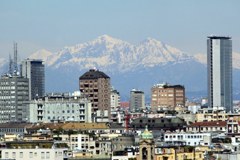
CIPRA's point of view: New solidarity between the Alps and metropolitan areas
Various political actors are pushing for the development of a macro-region for the Alps. CIPRA also says yes to an Alpine macro-region - but only within a clear framework. This offers the opportunity to make the rest of Europe aware of the issues facing its Alpine regions.
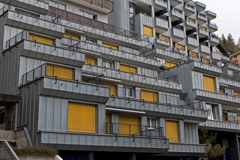
Swiss want to see fewer second homes
Most Swiss people have approved the "Stop the never-ending building of second homes" initiative, providing mountain communities with more protection for landscapes. But the building moratorium is not universally popular.
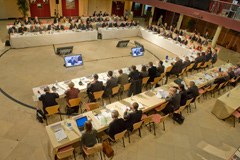
The Alpine Region as a macro-region?
The EU already has a macro-region strategy for the Danube Region and the Baltic Sea. So why not also for the Alpine Region? At the beginning of July, the Arge Alp Working Group advocated a resolution calling for a "macro-region for the Alps".
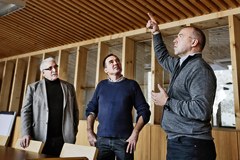
Alpine Convention: Sense and Sensuality
Climate change mitigation in construction and renovation is tantamount to providing for the future; it also makes economic sense. Better still, the Konstruktiv architecture award shows how sustainable construction can also become a sight for sore eyes. CIPRA co-initiated the award in order to publicise exemplary solutions. Imitations expressly permitted!
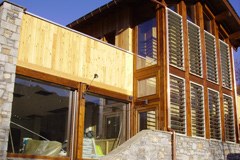
Climalp/“Alliance in the Alps”: Infected with good ideas
Ideas spread like viruses. They infect someone, who in turn infects someone else, and if they are good and strong, they spread like an epidemic. Energy-efficient construction is one such viral idea. On 14 September 2009 one could observe how it leapt from Vorarlberg to the French department of Savoie. Austria’s westernmost federal province is widely regarded as a centre for innovative timber construction. Concentrated here are a strikingly large number of architects, sawmills and carpenters who use wood as a traditional building material but in an ecologically advanced way – a large-scale workshop for creating a forest-sourced living environment.
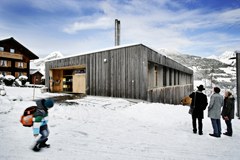
Sustainable Alps: Architecture Prize Awarded
Constructive, the Alpine-wide architecture award for sustainable construction and renovation has been presented to three architects and developers. Three further projects are euqally to be commended.
Publication: The Alps in 2010
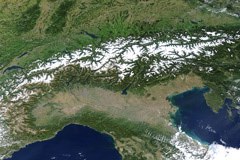
The new publication titled The Alps by the Permanent Secretariat of the Alpine Convention provides a comprehensive overview of the Alps, including a wealth of cartographic material. For over a thousand years the Alpine landscape has been used as a cultural landscape.
Publication: land management in mountain areas
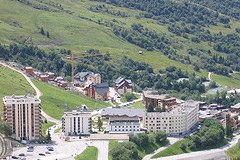
The current issue of the bilingual Journal of alpine research is running a feature on land management. It is a subject on which scientific research is sparse, even though it is of increasing concern for Alpine local authorities.
Natural hazards: an incalculable risk for road and rail?
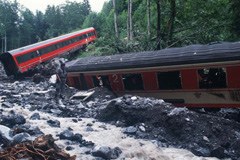
Time and time again avalanches, debris-flows and rock falls result in roads being blocked and railway tracks being swept away, causing fatalities. The Alpine Space Project PARAmount is looking to bridge the gap between society's demands on transportation routes and the outline conditions defined by nature.
Conference on demographic change in the Alpine region
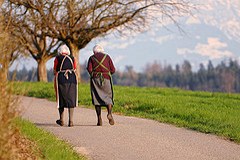
The Alpine Space Forum, to be held in Innsbruck/A from 22 to 23 February 2011, focuses on coping with demographic change in the Alpine region. The Alps are particularly affected as settlement areas are limited and many Alpine communities are located in the peripheries.
ForumAlpinum 2010: proceedings now online
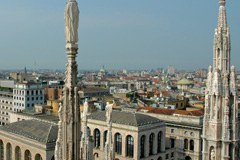
The 9th edition of the ForumAlpinum was held in Munich/D in early October. Titled Metropolises and "their" Alps it explored from scientific and political angles the relationship between the Alps and large cities along the Alpine Arc Further on the plenary talks and workshops focused on the relations between large cities and climate change, biodiversity, geo risks, and the European macro-region "Alpine Space".
cc.alps showcases future mobility in the Alps
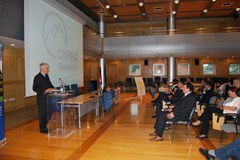
In September CIPRA focused on the issue of sustainable mobility and transport as part of cc.alps and co-organised two events on these topics.
climalp video: living in a plus-energy house
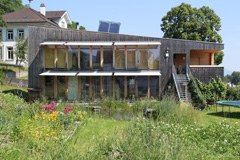
CIPRA's climalp project demonstrates that energy-efficient houses built using regionally sourced timber are highly beneficial when it comes to living comfort, the climate, and the regional economy. A recent video featuring the single-family home of the Götz family built in Switzerland's Rhine valley in 2004 illustrates what sustainable, climate-friendly building can look like in practice.
CIPRA Yearly Symposium 2010: "The Alps Adapting to Change"
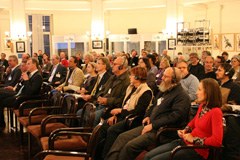
CIPRA's 54th Yearly Symposium was held in Semmering/A (14-16 October 2010) to the motto of "The Alps Adapting to Change - Peripheral Regions Between Wasteland and Hope". It clearly showed that decision-makers are only now beginning to perceive the problems remote areas within the Alps are faced with. Unsurprisingly there were no patent remedies to the problems these areas have to contend with - indeed the circumstances and claims to exploitation in individual regions of the Alps are far too diverse and need to be countered in just as many ways. What remains is a need for debate and action for a sustainable, future-orientated development of peripheral rural regions in the Alps.
European mountain areas: focusing on trendsetting projects
In mid-September 350 experts and interested participants from 23 countries gathered in Lillehammer/NO to discuss the implementation of innovative projects in European mountain areas. By now in the mountains of Europe there are already multiple trendsetting projects in progress. One of the conclusions reached by the experts is that a better usage needs to be made of that potential, and that it also needs to be expanded further.
CIPRA Yearly Symposium: marginal creativity...
This year's CIPRA Symposium focuses on the socio-economic margins of the Alps. Why "margins"? Because the nearest hospital is a far away and the post office is only open in the morning; because the towns and cities are beckoning, and nature is gaining more and more ground. The prevailing process of urbanisation has little in the way of prospects to offer these mountain regions, whose potential is already low.
Discovering common ground
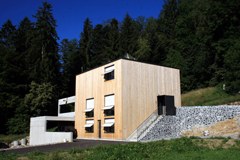
Liechtenstein is a small country, so you’re always bumping into people. And although everybody sort of knows everybody else, they don’t really. Energy-efficient construction is a bit like that. Or rather, it was until October 2009. It was then that CIPRA, which is better known for using its climalp project (see box) to circulate know-how on energy-efficient construction and renovation throughout the Alps, brought its own people together for a change.
Towards happy shrinking
Always more - the world will become better and better as long as material well-being grows. Nobody asks what this costs…until the system collapses. The present financial and economic crisis is giving us a taste of it. The Alps are now among the losers, but could be among the winners if they rise to the challenge. Must growth in principle be rejected?
New compacts on Transport and Spatial Planning now online
The assessments of climate response measures for the areas of Transport and Spatial Planning have been available online since the end of February. Both background reports (or "compacts") can be downloaded from www.cipra.org/en/cc.alps (de, en).
The new CIPRA compacts Traffic and Spatial Planning are on-line
The results of the climate protection measures taken in the areas of 'Traffic' and 'Spatial Planning' are now accessible on-line. At www.cipra.org/en/cc.alps (de/en) both of the background reports - so-called 'CIPRA compacts' - 'Traffic and Climate Change' and 'Spatial Planning and Climate Change' can be downloaded.
The construction industry as a key to the problem of climate change
The information provided through cc.alps is now available in the form of focussed background reports called Compacts, which can be downloaded from the CIPRA website at www.cipra.org/de/cc.alps/ergebnisse/compacts . The first three Compacts - on Energy, Nature Protection, and Construction and Refurbishment - address their subjects with reference to climate change in the Alpine context. The authors list and analyse activities relating to climate change mitigation and adaptation, assessing them for sustainability, explaining the conflicts of interest involved, and presenting examples of good practice.
New builds to meet tough climate requirements by 2020
From 2020 new builds in the EU will have to comply with tough energy balance requirements. Last week representatives of the European Parliament and EU states agreed that new builds should in future have virtually zero greenhouse gas emissions. Any remaining energy requirements should also be met essentially from renewable sources. These stipulations are to come into force two years earlier for public buildings.
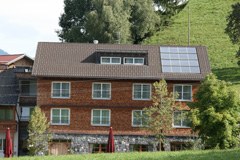
New builds to meet tough climate requirements by 2020
From 2020 new builds in the EU will have to comply with tough energy balance requirements. Last week representatives of the European Parliament and EU states agreed that new builds should in future have virtually zero greenhouse gas emissions. Any remaining energy requirements should also be met essentially from renewable sources. These stipulations are to come into force two years earlier for public buildings.
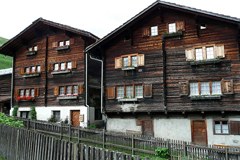
AlpHouse combines traditional trades & crafts and energy efficiency
The new three-year Alpine Space Project entitled AlpHouse was launched in early October. AlpHouse strives to enhance the competitiveness of SMEs, especially in the area of trades & crafts, by providing them with the knowledge, skills and tools for top-quality renovations of old buildings in the Alpine region.
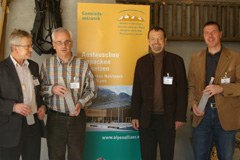
Latest edition of the Journal of Alpine Research now available online
The latest edition of the international and multidisciplinary "Journal of Alpine Research" is now available online under the title "Mountain Regions as Referents for Collective Action".
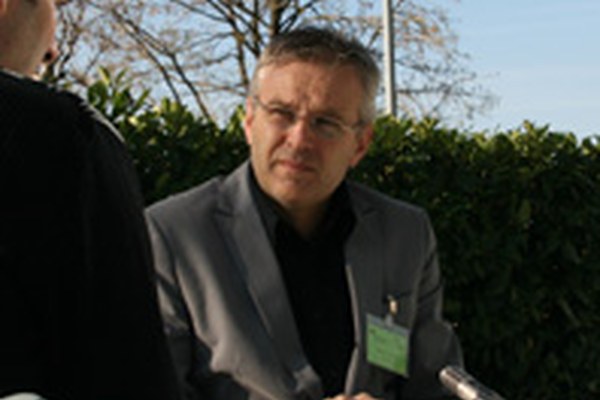
A cool head in conversation: Norbert Lantschner, Director of the ClimateHouse Agency in Bolzano/I "The cleanest energy is the energy I don't need"
The ClimateHouse Agency in Bolzano has won one of the seven prizes of the CIPRA's cc.alps Competition for its energy saving initiatives. We spoke to its Director, Norbert Lantschner at our "Cool Heads in the Hothouse" conference.
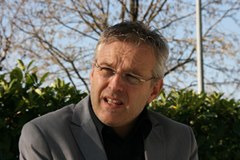
Energy-efficient buildings under discussion
The Director of the Passive House Institute in Darmstadt/Germany, Wolfgang Feist, and the Director of the ClimateHouse Agency in Bolzano/I, Norbert Lantschner, have responded to questions about energy-efficient construction in interviews.
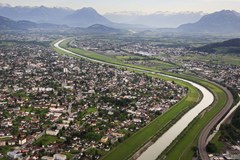
Latest update on ecological networks in the Alpine region
CIPRA has just expanded and updated its online dossier on "Relevant Instruments Relating to Ecological Networks in the Alpine Region".