
Articles
International event on the management of protected areas
The Third International Conference on Monitoring and Management of Visitor Flows in Recreational and Protected Areas is to be held in Rapperswil/CH from September 13th to 17th.
Ländergender - cross-border gender mainstreaming
As part of the Interreg IIIA Ländergender Project the governments of Vorarlberg/A, St. Gallen/CH and Liechtenstein plan to pool their efforts aimed at equal opportunities for men and women. The aim is to co-ordinate - and assist with - the implementation of gender mainstreaming in the regional administrations of the Lake Constance Region.
Swiss FSC wood for Harry Potter
(12.01.2006) The latest volume of Harry Potter (in English) was printed largely on eco-friendly FSC-certified paper from the Swiss Alps. The FSC abbreviation stands for Forest Stewardship Council and is a guarantee of ecologically sound and socially and economically sustainable forestry activities. The use of FSC paper was one of the demands made by J.K. Rowling, the star author of the Harry Potter series.
International Master of Landscape Architecture
(12.01.2006) The Master of Landscape Architecture (IMLA) at the University of Applied Sciences Rapperswil/CH is to be expanded in 2006, and will now also be available jointly at the Universities of Nürtingen-Geislingen/D and Weihenstephan/D.
Alpine landscape too bright at night
Swiss researchers have conducted a study to examine the extent to which man-made lighting has penetrated mountain regions since the 1970s. The comparison of satellite imagery shows that areas which previously were lit only in isolated spots - if at all - are now increasingly exposed to night time lighting.
New issue of the Journal of Alpine Research series
The latest issue of the Revue de Géographie Alpine series comprises five specialist articles on a variety of topics. One article examines the causes of flooding and the measures that are necessary to prevent it based on the example of the Isère/F region while another article focuses on sustainable water management in general.
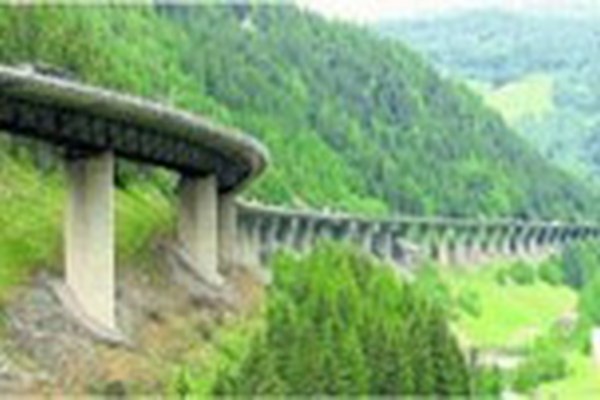
International conference on cross-alpine traffic
The international "Transport Across the Alps" conference is to be held in Lucerne/CH from 1 to 3 December. Key issues to be addressed at the conference include the impact of road traffic along the main alpine thoroughfares, the influence of statutory and political provisions on transit traffic and the interactions between transport, regional development, tourism, the environment and the economy.
Alpine summit flora undergoing rapid change
As part of their study on the "Influence of Climate Change on Succession Processes and Population Dynamics of Vegetation in Alpine Environments" research teams at the universities of Hanover/D and Zurich/CH have concluded that the rate of change in the floristic composition of vegetation in the Swiss Alps is increasing all the time. According to the experts this trend is consistent with global climate change.
Swiss Bird Index tracks Alpine birds
The Sempach Ornithological Station and the Swiss Association for the Protection of Birds [Schweizer Vogelschutz] have developed a Swiss Bird Index (SBI) modelled on stock exchange indices.
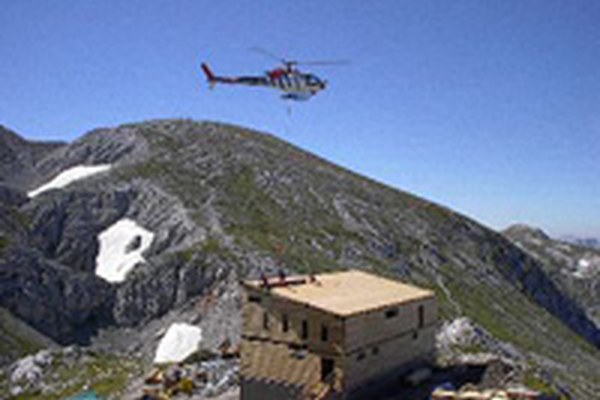
Mountains and the modern age: innovative construction at high altitudes
The Austrian Tourist Club [Österreichischer Touristenklub] recently opened the first high-alpine passive building, namely the Schiestlhaus am Hochschwab/A at 2,153 m.
Decrease in water runoff from the Swiss Alps
A new study analyses the impact of a potential climate change on hydrological discharge regimes from the Swiss Alpine region for the period between 2020 and 2050. Eleven catchment areas with different glaciation rates and altitude ranges were examined.
Why wait? Pull down those unused mountain installations now!
Anyone who comes across unused installations or buildings while out hiking or mountaineering in the Swiss Alps should take part in the Wilderness Olympics 2005 and notify Mountain Wilderness (MW) of their "find".
Alpine transit exchange - a feasible, efficient and cost-effactive solution
An Alpine transit exchange is seen as a viable option for promoting a shift from road to rail for transalpine heavy goods vehicle traffic. A report commissioned by the Swiss Ministry of Transport has confirmed the technical feasibility and economic acceptability of such a solution.
Snowcats and man-made snow as a threat to plant diversity
The number of plant species growing on mountain slopes used for ski trails in Switzerland is eleven percent lower than on adjoining sites. The reduction is especially striking in the case of woody and early flowering plants.
Breakthrough in the Lötschberg railway tunnel
28 April saw the breakthrough right in the middle of the almost 3-kilometer-long Lötschberg rail tunnel under the Swiss Alps.
Mistletoe area boundaries on the ascendant
Scientists at the Swiss Federal Institute for Forest Snow and Landscape Research have found specimens of mistletoe at altitudes of up to 1500 m. It was previously thought that in Switzerland mistletoe grew only in areas below 1000 m above sea level.
Research on the economic significance of the landscape
What is the monetary value of the Alpine landscape for the resident populations and tourists? This question was studied in the framework of Swiss National Research Programme NFP48 "Landscapes and Living Spaces in the Alps".
2005 Swiss Mountain Water Award launched
The Governmental Conference of Alpine Cantons (GCAC) has launched the Swiss Mountain Water Award, which is endowed with a total of CHF 50,000. The objective of the competition is to initiate and promote practical water projects capable of making a substantial contribution to increased net output in the mountain areas of Switzerland in commercial, ecological, social and/or institutional terms.
CIPRA conference on cities in the Alpine space
CIPRA's annual conference will be held in Brig/CH on 22 - 24 September. The subject of the 2005 conference is Alpine cities and their role as sustainability actors, with a focus on the following main aspects: - design, management and optimization of relations between Alpine cities and the surrounding areas; - networking, alliances and enhanced co-operation and synergies among Alpine cities to achieve effective positioning in the face of competition from other European locations.
Artificial high water affects ecology of running water
A new WWF study shows that the artificial high-water (surges) and low-water (sinks) caused daily by hydraulic power plants are having disastrous repercussions on the ecosystem of running water.
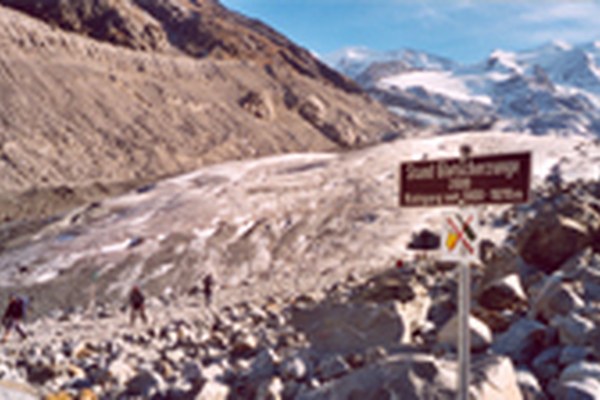
Glaciers melting faster than anticipated
A new study by Zurich University using satellite images to analyse the surface area of 930 glaciers has shown that Switzerland's glaciers lost around 18% of their surface area between 1985 and 2000.
Storm Lothar not an ecological disaster
Storm damage does not pose a threat to the long-term conservation of Switzerland's forests; rather it contributes to forest renewal and promotes biodiversity.
Certification system for sustainable hotel establishments
The Ibex Label is to be used to certify Swiss hotel establishments which excel through particularly sustainable and social management. Depending on achievements one to five of these Ibexes are to be awarded by the Association for Economy, Ecology and Society.
New publications show: biodiversity still on the wane
The "Biodiversität in der Schweiz" (Biodiversity in Switzerland) study published by the Biodiversity Forum Switzerland has concluded that genetic diversity and biodiversity are more at risk in Switzerland than in most other European countries.
As free as a bird? Light pollution a hazard for migratory birds
More and more migratory birds are falling prey to night-time lighting conditions as they fly south. A closed cover of low-lying fog such as the one that prevailed over large areas of Switzerland in mid-October seriously disrupts the migratory birds' ability to orientate themselves; combined with towns and villages that are brightly lit at night it can represent a death trap for the birds.
Landmark NEAT Project under pressure to cut costs
According to the Swiss Federal Office for Transport total costs of Switzerland's "New Alps Transversal Route" (NEAT) are likely to be CHF 302 m higher than calculated in the summer, due essentially to geological fault zones, uncertainties about the planned route and costly rail securing techniques.
Are the Alps fit for the future? "Future in the Alps" project gets underway
At the Alpine Week 2004 in Kranjska Gora, Slovenia, the International Commission for the Protection of the Alps (CIPRA) presented its new project entitled "Future in the Alps", a broad-based project aimed at promoting sustainable development in the alpine region.
Greater co-operation to protect against natural hazards
Switzerland, Germany, Austria and Liechtenstein intend to co-operate even more closely to protect against natural hazards in the Alps. This decision was taken by the four German-language Environmental Ministers at this year's meeting in Potsdam/D. The Ministers concurred that natural catastrophes in the Alps were likely to occur more and more often despite all the efforts being made with regard to climate protection.
The Emmen valley - The vision of a valley heated without oil
Timber and solar energy rather than oil, gas and electricity are to be the heating resources of the future in Switzer-land's Emmen valley. Although the Emmen valley region is densely forested, each year it still buys in some CHF 30 m's worth of oil, gas and electricity - while more than half the wood accruing each year simply rots away in the region's forests. It's a situation the "Oil of Emmental" project hopes to remedy.
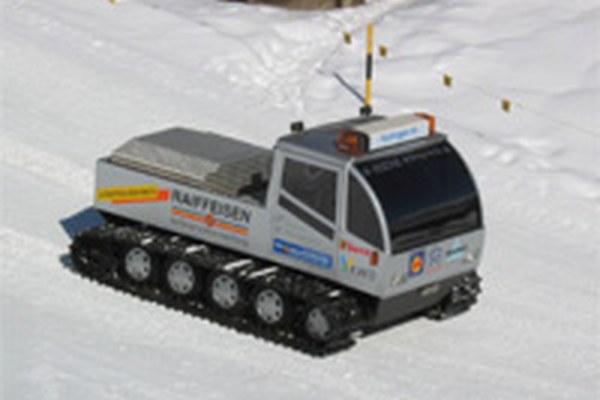
Hydrogen-powered piste vehicles in the Alps
The Swiss association Swiss Alps 3000 has launched a new campaign aimed at zero-emissions mobility in the Alps. As part of the campaign it presented the prototype of a hydrogen-powered piste vehicle. The first vehicle of this type was tested during winter 2003/2004.