Winter Olympics: the Alps are more than just a playground
Major, global sports events have the power to fascinate and inspire. Winter sports hold a special place in the Alps, with their deep-rooted tradition and passionate following. We however believe that, as they currently stand, the Winter Olympic Games are neither environmentally nor socially acceptable. Despite promises of reform, recent developments such as the preparations for Milano-Cortina 2026 and the 2030 Games in France, as well as the “privileged candidacy” of Switzerland for the Winter Games 2038, all prove that the Olympic model remains unsustainable. In recent decades, referendums (e.g. in Innsbruck, Sion, Munich, Grisons) have several times demonstrated that large segments of the population are no longer willing to pay the price of the Winter Olympics.

The negative ecological and social impacts of the Winter Olympic Games have been documented in host regions across the globe, affecting nature and local communities alike. In this paper, however, we focus on the Alps, where these challenges are particularly acute and directly connected to our mission for sustainable development. The Alps constitute a sensitive natural and cultural space that is unsuitable for the Winter Olympics in their present form. The intensification of the climate and ecological crises in recent decades underlines the fact that vulnerable mountain regions are no longer suitable venues for environmentally harmful major events. They exceed the carrying capacity of the predominantly small-scale Alpine regions. The requirements of the Winter Olympic Games with regard to traffic infrastructure, sports facilities and accommodation are so high that they cannot be sustainably met in the Alps. The negative effects of the Winter Olympics on people and nature outweigh the benefits and consequently cannot be justified.
Olympic Agenda: empty promises
Nor do the Olympic Agenda 2020 and the Olympic Agenda 2020+5 represent any real progress: despite their ambitious language and commendable intentions, they have failed to produce tangible change in how the Winter Olympic Games are planned and implemented. Even if new IOC guidelines allow for the Games to be dispersed over several venues and even countries, these are not followed by the host countries, as has been the case for Milan-Cortina 2026. The selection of France to host the 2030 Winter Games, including events in the southern city of Nice, contradicts the principle of climate adaptation. Furthermore, host countries are not bound to the minimum commitments in terms of sustainability that they made in their bids. In our view, the promises made in such bids are to be considered a minimum threshold upon which only improvements can be made. Countries whose sustainability performance falls below these standards are to be unmasked and penalised.
Growing pressure on nature and the landscape
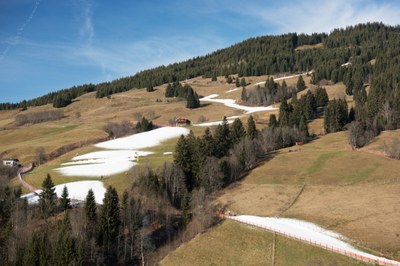
Ever more space is required for ski trails, lifts and cable cars, stadiums, participant accommodation, access roads, car parks and other infrastructure, all of which will have serious consequences for the natural environment and landscape. For decision-makers within the IOC and many politicians in the host cities and countries, climate change – a major problem in the Alps – seems to be irrelevant. Changing weather patterns and inadequate snow cover are either ignored or presented as a purely technical challenge. In order to guarantee the necessary snow cover, artificial snow (or “technical” snow, as they call it) has to be produced with the help of ever more technical infrastructure (including snow cannons, reservoirs with their wide-area drainage systems, pipe systems and cooling towers, as well as “snowfarming”). Such installations have an increasingly negative impact in terms of landscape, energy and water.
Economic disaster for peripheral regions
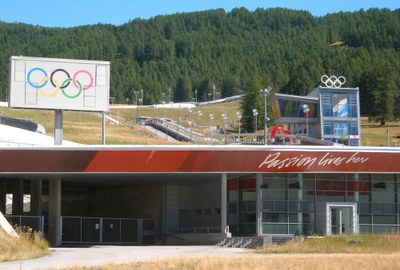
An honest cost-benefit analysis can only result in a negative balance for taxpayers. There is not one robust study showing that any Olympic Games held in an Alpine region have made a positive, long-term contribution to economic development for the public. On the contrary, experience shows that Olympic Games have only short-term economic effects, if any. What they most commonly produce for the host cities and regions is debt and pressure on both living costs and housing markets. By focusing on snow-dependent winter sports in the Olympic context, peripheral mountain regions are usually left with debts and unused sports ruins: typical examples are the remains of the sports facilities for "Torino 2006", for example in the Italian valleys of Susa and Chisone. The 2026 Winter Olympics in Italy have once again revealed the systemic flaws of the Olympic model: despite commitments to sustainability and the promise of no burden on public finances, over 5.7 billion euros are being invested in infrastructure projects, compared to the initially planned sum of 1.5 billion , with many of these lacking any environmental assessment or long-term utility. The construction of a new bobsleigh track in Cortina – against the IOC’s own recommendations – exemplifies this disregard for ecological and financial responsibility.
IOC: meaningful reforms needed
The IOC continues to operate with a lack of transparency and accountability. Its host city contracts undermine democratic processes, while its sustainability agenda remains largely symbolic. The disregard for public consultations, environmental concerns, or financial prudence – as seen in recent Games – all confirm that the IOC is unwilling to implement meaningful reforms. Moreover, topics like sustainability and the environment, which are of great concern to the municipalities and regions of the Alps, do not feature highly on the IOC’s agenda. CIPRA is calling for a fundamental reform of the IOC and the framework for planning and holding the Winter Games. The Winter Olympics should act as a symbol of peace and freedom, planned and held in a way that is transparent, inclusive, and both socially and environmentally acceptable.
Monitoring Milano-Cortina 2026 and France 2030: a call for responsibility
We will be closely monitoring the planning and implementation of the 2026 Winter Olympics in Italy and the 2030 Games in France. These events represent critical tests for the credibility of the IOC’s sustainability commitments and the willingness of host countries to prioritise long-term regional well-being over short-term prestige. We call on all responsible authorities – from local governments to national Olympic committees and the IOC itself – to ensure that these Games do not repeat the mistakes of the past.
This will include:
- No new constructions and respect for environmental limits
- Ensuring full transparency in planning and budgeting
- Meaningful involvement of civil society and affected communities in decision-making
- Prioritising climate adaptation and sustainable mobility
- Leaving a positive, long-lasting legacy, both for the host regions and their inhabitants and for nature, including measures to protect the climate.
The Alps cannot afford another decade of broken promises. They are more than just a playground for the Olympics!
Further information
The Winter Olympics
Winter sports reach a tipping point